
The workshop model was built for a world where people had time to kill on a Saturday morning and a second car to get home. Young South Africans do not live in that world. They work irregular hours, live in complexes with strict access rules, and expect services to arrive at their door like a Mr D order. The mobile mechanic is not a downgrade from the garage; it is a different product entirely. For a certain kind of young entrepreneur, it is a much better business to own.
What a mobile mechanic actually does
Dayne runs a mobile garage across the Cape Town metro. He arrives with a bakkie full of tools, plugs an OBD-II scanner into your car in your office parking bay, and tells you within minutes whether that engine light is a R200 sensor or a R20,000 rebuild. His diagnostics start at R450. A general service, oil and filter included, runs from R650. Brake work begins at R600, electrical repairs at R400. If your battery dies at Canal Walk, he will come to you for a R250 callout fee.
The core pitch is not cheaper, but located where you actually are. The customer saves the Uber to the workshop, the half-day of leave, and the uncertainty of whether the quote will triple once the car is inside and immobile.
For the mechanic, the economics flip completely. There is no rent on a bay in Ottery or Randburg, no rates, no security guard, and no waiting for walk-ins. The vehicle is the workshop, and the customer base is built through WhatsApp, Google reviews, and repeat business from people who never want to sit in a waiting room again.
What it costs to start
A traditional workshop in a decent location will chew through R500,000 before you have fixed a single car. The mobile route needs between R50,000 and R150,000, and much of that is the bakkie itself, bought second-hand and branded with your name and number.
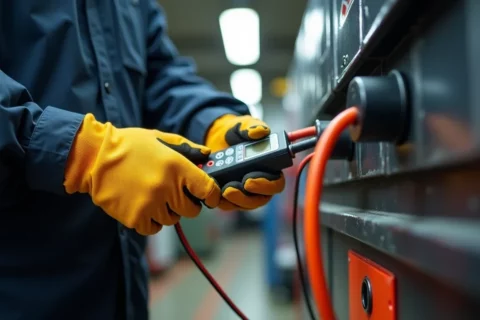
The tool list is specific and non-negotiable. You need a comprehensive socket and spanner set, a quality OBD-II scanner that can read manufacturer-specific codes, a multimeter, brake tools, fluid extractors, a robust jack and stands, and the safety equipment to use them legally. A reliable panel van or bakkie carries it all. Register the business with CIPC, get your SARS tax number, check your municipal bylaws for mobile operation permits, and buy public liability insurance. Skip any of these and you are not a business, you are a person doing risky favours for cash.
The qualification floor is a National Certificate in Automotive Mechanics at NQF Level 2-4 from a TVET college like Northlink or False Bay. Dayne has ten years of hands-on experience, which lets him price confidently and diagnose fast. The certificate gets you in; the hours get you good.
How the money works
A busy mobile mechanic doing three to five jobs a day, five days a week, can gross R30,000 to R80,000 a month. Four general services at R650 each, twenty days a month, hits R52,000 before parts costs. The oil and filter for that service might run R200-R400, leaving healthy margin. Brake pads vary widely by vehicle, but the R600 starting price absorbs the parts cost and still pays for the hour.
Operating expenses are real and must be tracked. Fuel alone can hit R3,000-R6,000 a month if you are crossing the Cape Town metro daily. Vehicle maintenance, insurance at R1,000-R2,500, mobile data for bookings and maps, and the occasional snapped tool all come out of gross. Net income for a well-run operation sits between R15,000 and R40,000 monthly. Compare that to the R8,000-R20,000 a workshop technician typically earns as a salaried employee, with no control over pricing or schedule.
The difference is the optionality. A mobile mechanic can choose to work Saturday mornings for premium rates, or not. They can take December off, or chase the breakdown spike when everyone drives to the coast. They can add a second van and a junior technician, or stay solo and keep every rand.
The tech stack that makes it possible
The OBD-II scanner is the headline tool. It turns a driveway into a diagnostic bay, reading error codes and live data streams that would have required a mainframe twenty years ago. The real operational lift comes from the software around it.
Booking platforms like Booksy or Setmore let customers schedule while you are under another car. Yoco or SnapScan take payment on the spot, with no cash or “I will EFT you tonight” that never arrives. A simple spreadsheet or lightweight CRM tracks customer history, so you know that this Golf’s timing belt was done eight months ago and the warranty is still live. GPS and route optimisation apps squeeze more jobs into a day, which is pure profit.
The mechanic who masters these tools moves faster, bills more accurately, and builds a data trail that makes the business sellable. The one who does not is stuck playing phone tag and guessing at quotes.
Where the model breaks down
This is not a universal solution. Heavy engine work, gearbox rebuilds, anything needing a lift or a clean room, still belongs in a workshop. Rain delays outdoor jobs. Extreme heat makes a bonnet too hot to touch. Parts availability can strand you if the supplier across town does not have the specific sensor for a 2019 Renault Duster.
The scope ceiling is real. The mobile mechanic does not try to be a full workshop. They capture the 70% of jobs that do not need one, and they capture them at the customer’s convenience premium.
How to stand out in a crowded market
Generalist mobile mechanics are already common in every major metro. The ones who thrive pick a lane and own it: European luxury cars with their proprietary software and paranoid owners, or fleet maintenance for small delivery businesses that cannot afford downtime. Pre-purchase inspections at R500 a pop deliver a detailed report that saves a buyer from a lemon. Some operations now offer a mechanic to collect and deliver your car, taking convenience one step further for customers who do not want to be present at all.
Transparent pricing is non-negotiable. State the rate upfront, itemise parts and labour, and never add a “sundries” line that smells like padding. Follow up after the job. Guarantee the work for three months or 5,000km, whichever comes first. Build a Google Business profile and beg for reviews from every satisfied customer. In this business, search ranking is the new workshop location.
Who this is actually for
The mobile mechanic path suits a specific personality: someone who likes the puzzle of diagnosis more than the repetition of production line work. They tolerate uncertainty, manage their own schedule, and sell themselves without a manager handing over allocated jobs. They own their mistakes because their name is on the van.
It is also for the young person who looked at the traditional trades and saw only the bottleneck: years as an apprentice, decades to own a workshop, maybe. The mobile model collapses that timeline. You can be in business for yourself within months of qualifying, with capital requirements that a year of disciplined saving can cover.
The auto industry is not disappearing. It is fragmenting into specialisations, and the specialisation that trades rent for mobility, and waiting rooms for WhatsApp confirmations, is growing fast. For young South Africans who would rather build something they control than queue for something they do not, the mobile garage is one of the more honest businesses left.